Fiber optic cable as a transmission medium has, for some time, been
employed in the long haul or wide area network environment. Its
advantages with respect to large bandwidth, immunity to electrical
interference and security are well known.
In recent years there has also been a steady growth in the use of fiber
optic cable in the premises environment. As fiber optic cable prices
have decreased and cable connectorization has become easier to
accomplish, this medium has become increasingly popular for implementing
premises data communication networks - networks for either in-building
or manufacturing plant use.
When fiber optic cable is employed in long haul or the wide area
environment it is of the single-mode variety. In very elementary terms
you can think of the cable as allowing only a single 'ray of light' to
propagate from one end to another. Why is it single-mode? Because this
type of fiber optic cable has very low attenuation and consequently can
achieve the long distances between repeater required in this
environment.
When fiber optic cable is employed in the premises environment, it is
generally of the multi-mode variety. Again, in very elementary terms,
you can think of the cable as allowing a multiplicity of 'rays of light'
to propagate from one end to another. Multi-mode fiber optic cable has
more attenuation than single-mode fiber optic cable - you often lose the
'rays' propagating near the walls of the cable. However, this is OK. In
the premises environment you do not have to go as far as in the wide
area network environment and your signals can tolerate the increased
attenuation. Multi-mode fiber optic cable is also much less expensive
than single-mode fiber optic cable. This works for the premises
environment where cost is a much more sensitive issue.
There has been more and more activity in taking data being transported
on a premises data communications network and sending out on a wide area
network. One case may be taking data on a corporate LAN at one location
and then sending it out onto a wide area network to a corporate LAN at
another location. As the employment of fiber optic cable as a
transmission medium has grown carrying out this task has come to mean
converting the fiber optic signals from the multi-mode cable on the LAN
to signals appropriate for the single-mode cable used in the wide area
network. That is, a multi-mode to single-mode conversion has to be done.
The Model 279 is well suited to this task.
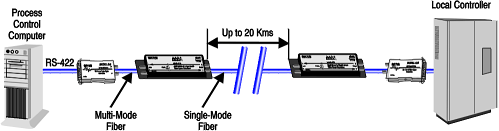
The illustration above shows a pair of Model 279s being used in just
this type of application. Here we see a process control computer at one
location communicating with a local controller on a factory floor, some
distance away, say in excess of 10 km. Considering that so much of the
communication is being carried out in the factory environment where
electrical interference is so much of the problem, it is desired to
effect the communication be fiber optics as much as possible.
Both the process control computer and the local controller send and
receive data through their RS-422 interface. The differential signaling
of RS-422 provides some protection against electrical interference.
However, it can not compete with fiber optic transmission. Thus, at both
ends of the link we show a conversion from RS-422 to multi-mode fiber
optic signals using the Model 272. The resulting communication can
employ the low cost multi-mode fiber optic cable to out to the walls of
the building where the computer and controller are located, the
boundaries of the respective premises. At these points conversion of the
multi-mode fiber optic signals to single-mode signals can be carried out
using a Model 279 at either end. The Models 279 can then be linked by
single-mode fiber optic cable which can reliably support transmission
over the 'longer than premises' 10 km + distance.
|


