Within the premises or local area environment the short haul modem is a
convenient device for configuring a reliable communications link. When
the distance between communicating data equipment gets beyond 100 feet
signals need 'to be boosted' or they will not be received and decoded
reliably. Using a pair of short haul modems in the link, one for
transmitting and one for receiving in each direction, boosts the signals
and gives the reliability.
However, a number of items always seem to come up when using a pair of
short haul modems to deal with this rather straightforward problem.
The first issue involves the need to satisfy data transmission and speed
requirements. They must meet the under application's needs. They also
need to be met relative to the interference environment within which the
communications is taking place. Certain environments, such as office
building settings, usually present relatively benign environments where
background noise is the only problem. However, they are not always
benign. The presence of air conditioning equipment and fluorescent
lights may present harsh interference conditions. Others settings, such
as manufacturing facilities, always present harsh environments. Here one
may have to deal with Electromagnetic Interference (EMI) from high
powered production tools, Radio Frequency Interference (RFI), power
surges and other deleterious effects.
Secondly, there is the matter of isolation. The need for isolation
arises when ground currents are present. In many instances the data
equipment communicating must be grounded at different points. Different
grounds imply different reference levels for voltages. Ground currents
are generated in an attempt to achieve equilibrium between different
ground points. From the perspective of communications such currents make
themselves known as an additional interference mode. Isolation provides
a barrier between different ground points. This barrier does not allow
ground currents to be generated. Isolation allows equipment being
grounded at different points to be connected together without the need
to worry about the interference due to ground currents.
Thirdly, there is the issue of the data interface. The RS-232 interface
still presents the most ubiquitous interface in the world. The ability
to take/direct data from/to this interface without any conversion eases
link implementation.
Fourthly, there is the matter of powering the modems. A modem needs
electrical power to work. Many times the network installer can look
around for an electrical outlet and find that either one is not
available or is quite far from the device and currently in use.
Carrying out premises data communications using fiber optic cables in
the harsh interference environment presents several ready advantages.
First, there is the bandwidth potential. Applications that require very
higher data transmission rates can be easily accommodated. Secondly,
there is the protection that fiber optic transmission provides against
the variety of deleterious effects which plague transmission over copper
cable. These include the resistance that fiber optic transmission has to
Electromagnetic Interference (EMI), lightning induced current surges and
ground loops. Finally, there is the protection that fiber optic
transmission has with respect to 'tapping.' It is much more secure with
no effective radiation of the communication occurring out of the cable.
The Model 271 fiber optic line driver presents a convenient way of
dealing with many of the issues described above and bringing effective
data communications to the manufacturing environment. To begin with it
realizes a data communications link over fiber optic cable. Thus, it
obtains all of the benefits of fiber optic transmission with respect to
interference and isolation. The data interface to this modem is the
ubiquitous RS-232. The modem can achieve a higher than usual data
transmission rate compared to RS-232. In particular, it can achieve 56
KBPS asynchronously and operate either half or full duplex. Finally, the
Model 271 does not require any external power. It can power itself from
the transmit data line. Of course, if the user wants to employ wall
power there is the Model 271A which has this feature.
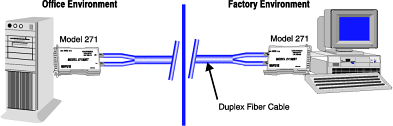
The illustration above shows the Model 271 in a typical application.
Here we have the entire operations of a corporation, both office and
manufacturing, housed in the same building. The interference environment
throughout the building is harsh. There is a need for a point-to-point
data communications link from a PC, located in the factory portion of
the building, to a mini-computer located in the office portion of the
building. There is no available electrical outlet near the
mini-computer. The link must be full duplex, asynchronously. Required
data transmission rates are not high, at most 50 KBPS. This is an ideal
situation for the Model 271. By realizing a fiber optic link it can
provide the protection against interference. It can protect against
ground loops if these are present. It can satisfy the moderate data
transmission rate needs in a full duplex, asynchronous manner.
Furthermore, it can operate at the mini-computer side without the need
for an available electrical outlet.
|


